
Updated on 17 Jun 2026
With the rise of AI-generated search results, chatbots, and large language models (LLMs), artificial intelligence has fundamentally changed how consumers discover products and services online.
In 2026, online search is no longer just about typing questions and keywords into Google. Now, searching for information online consists of asking questions, and receiving conversational answers directly from AI systems.
In recent years, you may have come across terms like AI SEO, AI optimisation, AI search, or Generative Engine Optimisation (GEO). While each wording varies, they all describe the same thing – the optimisation of your business not towards human readers or traditional search engines, but for AI systems that decide what information to surface, summarise, and recommend about your brand.
The facts and figures
By April 2026, Google Trends data showed that searches for “AI Optimisation” had risen by 200% year-on-year, while related terms including “AI SEO” and “Generative Engine Optimisation (GEO)” increased by 161% and 196% respectively. This shows a clear shift – businesses are catching on, and actively trying to understand how to remain visible in the world’s now AI-driven search environment.
- AI Optimisation +200%
- AI SEO +161%
- Generative Engine Optimisation +196%
The death of the click
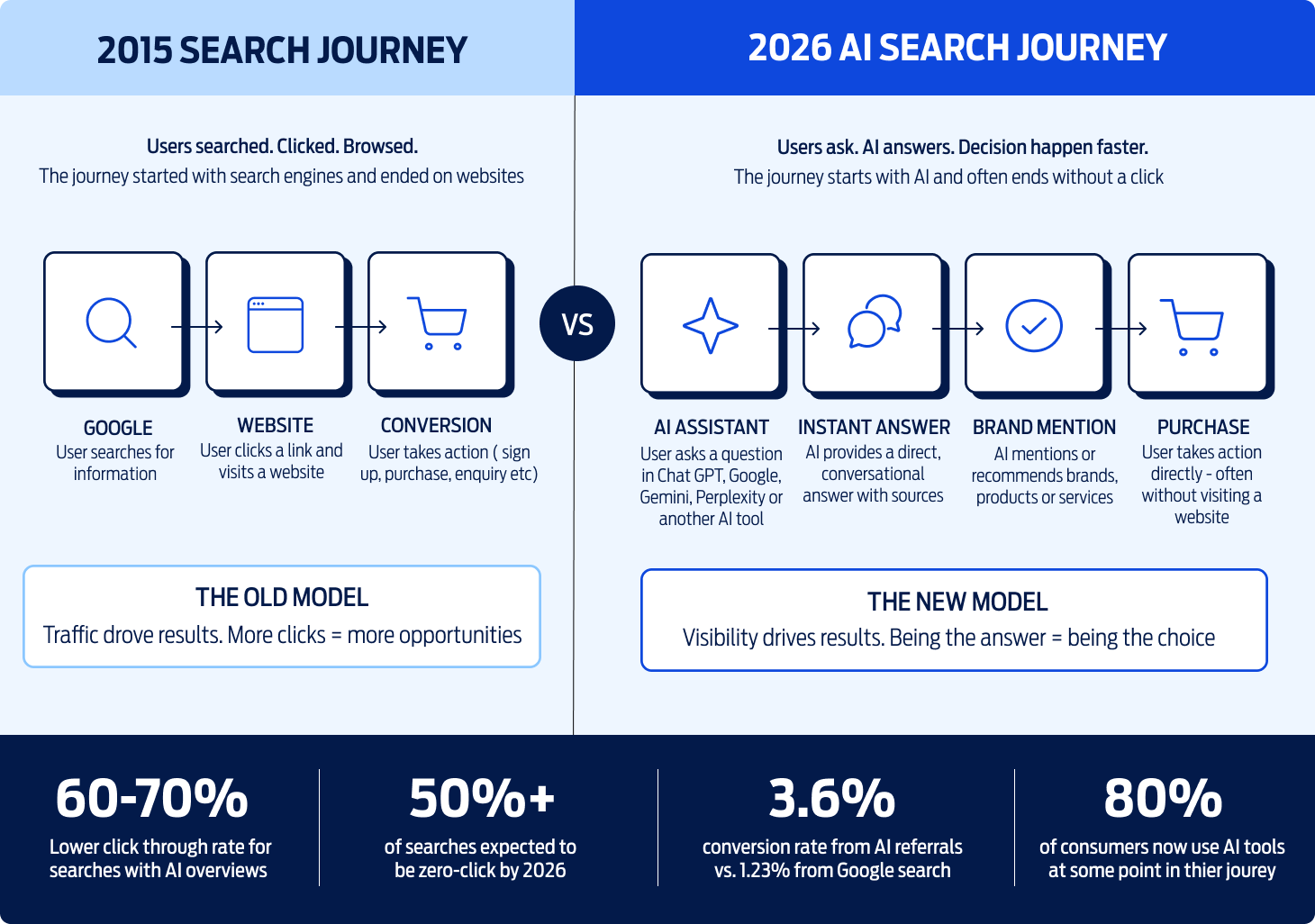
Research now suggests that nearly 80% of Google searches in 2026 now end without a click.
Instead of visiting websites directly, users now receive the answers to their online searches through Google’s AI Overviews, snippets, and other LLM-powered tools such as ChatGPT, Claude, and Perplexity.
This has created a major challenge for businesses that rely on organic traffic. Rather than optimising solely for high rankings on traditional search results pages, businesses must now rethink their online visibility strategies entirely – where in the era of AI search, the new goal is not just to be found online, but to to be selected by AI as the answer to users’ questions.
The shift from search engines to answer engines
For more than two decades, search engines worked by ranking web pages based on keywords, backlinks, and technical SEO signals.
Usually, users would browse multiple results, visit multiple websites, read multiple batches of content, and click through multiple times to find the information they needed.
Now, AI search changes this search method entirely. Instead of presenting a list of links, AI systems generate a direct answer by synthesising information from multiple high authority sources.
LLM tools, such as ChatGPT and Copilot. are leading this shift by allowing users to ask complete questions in natural language and receive instant responses, without needing to head to the SERP.
This means that businesses are no longer competing just for rankings but they are competing to become trusted sources that AI systems reference, summarise, and cite.
How AI systems decide what to surface
In the pre-AI era of online marketing, blog posts and web content would traditionally be written with a human reader in mind. However, modern websites are no longer built for the same recipient.
As AI systems crawl, interpret, summarise, and compare vast amounts of content in order to decide what information to surface, today’s websites must be adapted and optimised for bots and machines. The websites that make their content and information easy to interpret from a bots perspective are significantly more likely to appear in AI-generated responses.
What makes your content easier for AI to understand
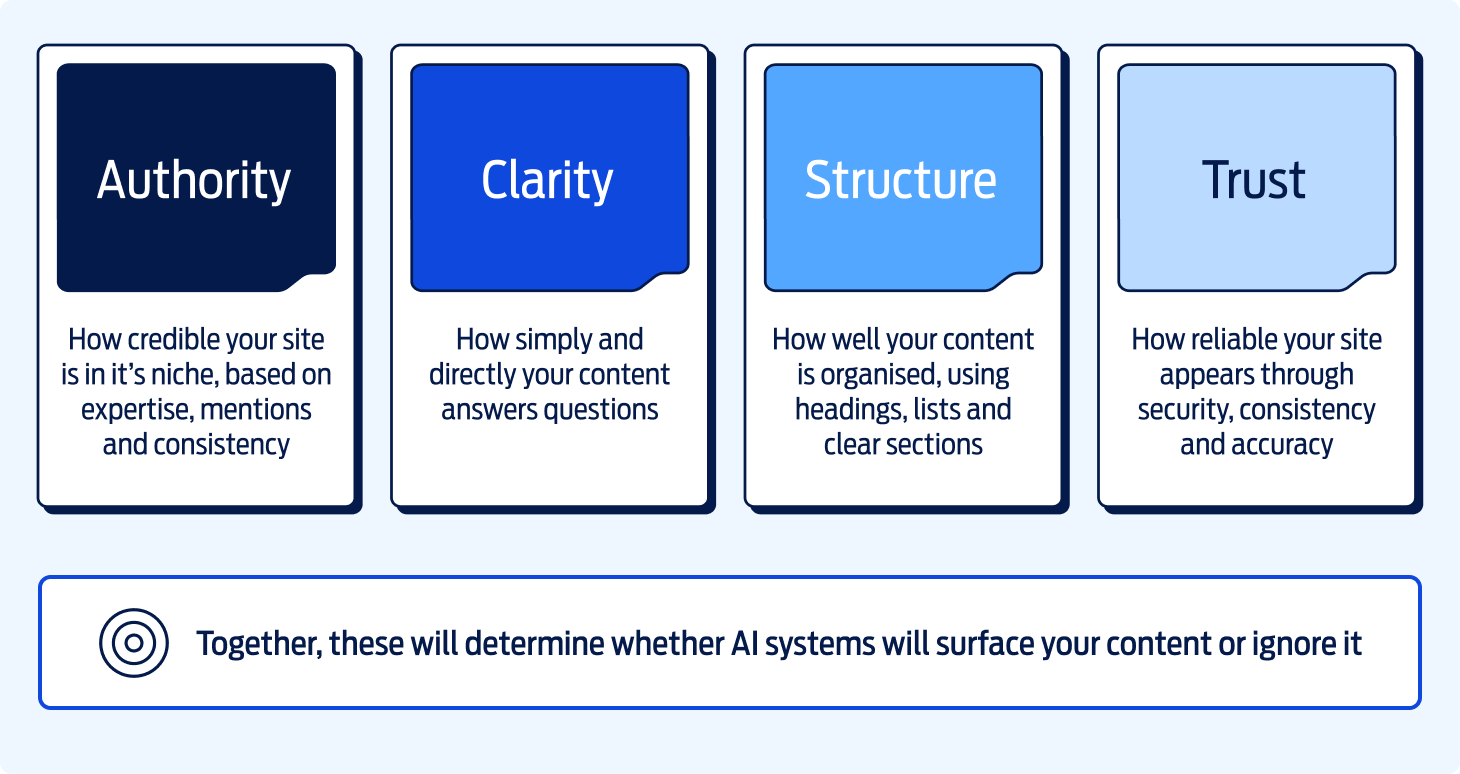
Your website will perform well in AI search results, depending on whether AI systems can trust, understand, and reuse your content in answers. So to improve visibility, businesses need to focus on 4 key signals – authority, clarity, structure, and trust.
How can I optimise my website for AI search?
To optimise for AI search, businesses need to make their websites easier for AI systems to understand, trust, and reference in generated answers. This means focusing not only on content quality, but also on structure, technical performance, and consistent brand signals. Here are a few simple steps to help you get started
- Start with a strong domain
Your domain plays an important and long-acting role in brand authority, helping AI systems associate your content with a single trusted entity over time.
For UK businesses, a .co.uk domain registration can help reinforce geographic relevance and local trust signals. Entity-reinforcing geo and service domains (e.g. LondonBikeRepair), service-led brand names (e.g. RapidBikeRepair), and hybrid formats that balance clarity with scalability (e.g. BikeRepairLondon), can help AI systems align your brand with user queries much more closely.
If you’d like to find out more about choosing a domain for AI search, head here: How to choose a domain name for AI search
- Write clear, structured content that directly answers questions
AI systems favour content that answers user questions quickly and clearly. So instead of writing purely for rankings, businesses should create content that explains topics directly, uses natural language, and avoids unnecessary complexity. You can achieve this by implementing FAQ sections, concise explanations, and clearly defined topic pages which will help AI systems extract and summarise information more accurately.
- Use headings and organised sections
Well-structured pages are much easier for AI systems to interpret. When structuring your content, utilise clear headings, subheadings, bullet points, and create logical page flow to help bots and machines understand the hierarchy and meaning of your content. This will help improve machine readability and should increase the likelihood of appearing in AI-generated search results and snippets.
- Build consistent brand signals across the web
Although we’ve spoken a lot about creating quality web content, AI systems also look for consistency across multiple sources when evaluating trust. Your business name, taglines, slogan, services, and contact information should appear consistently across your website, social platforms, external listings, third-party mentions, and wherever you may appear online.
- Ensure your website is technically stable and secure
Technical performance is a major trust signal in AI search. Fast loading speeds, secure HTTPS connections, mobile optimisation, and reliable uptime all improve how AI systems crawl and process your website.
Choosing a reliable hosting provider that can guarantee uptime (ideally 99.9%) and consistent performance, will ensure your website remains reliably accessible to both users and AI bots and machines.
- Create content that demonstrates expertise in specific topic areas
AI systems prioritise websites that consistently demonstrate expertise within a niche or specific topic area. Rather than covering too many unrelated subjects, businesses should build deep topical authority around specific areas of knowledge related to its brand, products or services.
This could take the form of high-quality guides, educational resources, or well-structured on-page and off-page insights, which will help position your brand as a trusted source that AI systems are more likely to reference and cite.
Final takeaway
Businesses that succeed in this new AI environment of search will need to become hubs of knowledge that combine strong content, clear expertise, and consistent branding.
They will need to prepare their websites to convert bots and high-intent users who arrive with more context and less browsing behaviour than before. But all in all, a business successful with AI search will no longer solely focus on being found online, but becoming trusted enough by AI to “become the answer” itself.