
Updated on 17 Jun 2026
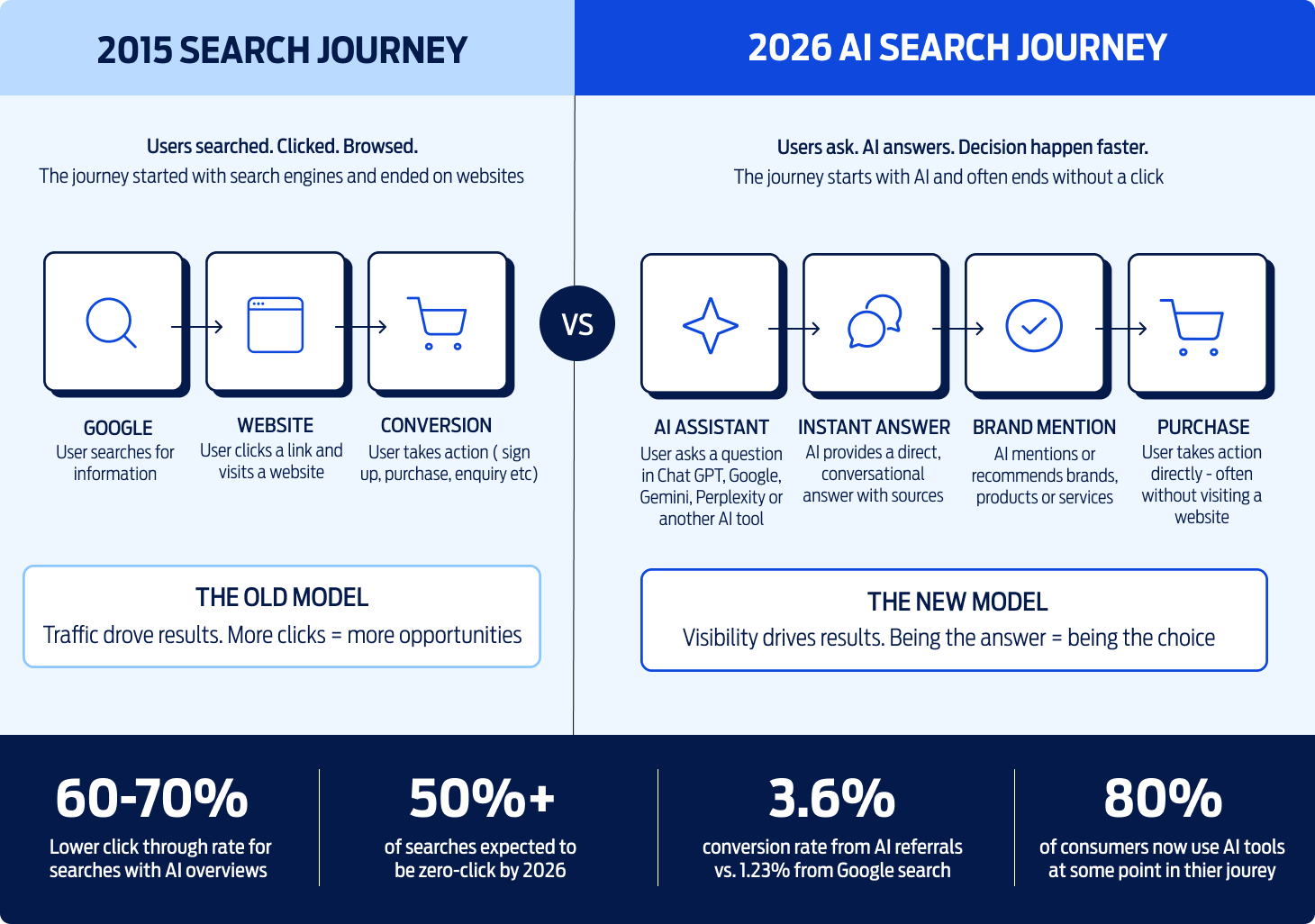
Do you remember when finding information online meant scrolling through 20-30 different websites, piecing together bits of information to answer a single question?
For decades, the internet worked in a simple way:
- Users searched Google
- They clicked websites
- Businesses converted traffic into customers
But in 2026, that model is rapidly changing. Today, platforms such as ChatGPT, Microsoft Copilot, Claude, and search features like Google AI Overviews, are answering our searches directly inside AI-generated responses, without users ever needing to visit a website.
As a result, research suggests that in 2026, over 80% of Google searches now end without a click, reducing organic traffic and click-through-rates (CTR) to websites.
So now that websites are no longer the end destination from a search, this raises a big question for modern businesses – do websites still matter in the age of AI search?
The zero-click era
Research has shown that in 2026, 80% of Google searches now end without a click.
Google’s latest feature, AI Overviews, have been shown to reduce organic CTR up to 34.5% depending on the industry and query type. Meanwhile, visibility for top-ranking results in position 1 on the search results page has seen decline by up to 58% when AI Overviews and summaries appear above them.
AI-generated answers work by summarising information instantly, pulling from multiple sources to generate a single response to a query. As a result, informational queries are being absorbed directly into AI-generated answers rather than traditional search results, reducing clicks and organic website traffic for websites and businesses.
Are traditional websites dying?
The short answer is no, but websites are changing. Your website is becoming less of a destination, and more of a data source or content hub.
In 2026 and beyond, websites are now moving away from being places where people gain knowledge, browse through products and services, or complete sales. They now function as:
- AI-readable content, knowledge, and information bases
- Structured hubs to reinforce trust and authority
- Verification layers for brands and E-E-A-T
- Content repositories that AI retrieval systems can scan and repurpose
So even if a user never visits your website directly, AI systems will still scrape, understand, and repurpose your website content. This means that businesses still require a professional domain, fast web hosting, structured content, and clear brand signals.
These elements will give your brand the best chance at being correctly understood, and consequently sourced and cited within AI-generated query responses.
How do AI bots read websites?
Modern websites are increasingly written for machines first, and humans second.
While humans browse web pages in search of information and answers to their questions, bots scrape, parse, and extract information into structured definitions to repurpose into user queries. Where human users browse pages visually, AI systems:
- Crawl content
- Extract meaning
- Break text into structured data
- Interpret relationships between concepts
- Build summaries and responses
Now well-written content adapted to the human readers isn’t enough, and the modern website must act as a machine-readable knowledge system.
Want to learn more about how to optimise your website's content? Head to our guide here: What is GEO?
How AI systems decide what to trust
While written content is more important than ever, AI search doesn’t just read or retrieve information – it also ranks trust. When deciding what to cite or summarise, AI systems will evaluate a combination of signals:
- Entity consistency: Does your brand appear consistently across the web?
- Topical authority: Are you repeatedly associated with a particular subject?
- External validation: How many backlinks, third-party mentions, online citations and brand reviews do you have?
- Content clarity: Is your content and information structured and unambiguous?
- Domain credibility signals: How are domain age, stability, HTTPS, and historical content quality associated with your domain?
Together, these signals will help AI systems determine whether your business is credible, relevant, and trustworthy enough to surface in search responses.
Because of this, building strong domain credibility should be one of the first steps in a successful AI search strategy.
Why your domain is your foundation block
The first building block to building an AI-ready website is choosing the right domain name.
(Click here to learn more about domain names: What is a domain name?)
Choosing your domain wisely will help AI bots assimilate your brand ‘entity’ to your brand, and will directly influence how AI systems understand, interpret, and classify your business.
AI systems use domains as a major signal of trust when deciding what sources to cite or summarise when responding to a user query, and will analyse your domain for:
- Entity identifiers (who you are)
- Trust anchors (how stable you are)
- Source signals (whether your content can be reused or cited)
The importance of domain extensions
Your domain can also be important if your business offers regional, local, or niche products or services.
For example, imagine a user searches for ‘gas plumber near me’. A co.uk domain will usually carry stronger local relevance for UK searches than a generic international domain.
Or ‘French bakery London’ for example. A niche domain like .london can help reinforce local or industry relevance.
Exact-match and brand domains
Historically, businesses tried to rank with keyword-heavy domains like:
- bestplumberbirmingham.co.uk
- cheaproofrepairslondon.com
But modern AI search is shifting away from this. Today, AI systems generally trust:
- real brands
- recognisable business names
- consistent entities
more than keyword-stuffed domains.
A clean branded domain such as (such as smithandsons.co.uk or clearwaterheating.com) often performs better long term because AI systems can associate it with reviews, mentions, citations, social profiles, maps, and other trust signals.
That being said, domain patterns can still help reinforce clarity and relevance when they’re natural, memorable, and brand aligned. For example:
- Geo and service domains (e.g. LondonBikeRepair)
- Service-led brand names (e.g. RapidBikeRepair)
- Hybrid formats that balance clarity with scalability (e.g. BikeRepairLondon).
Ultimately, a strong domain helps AI systems “understand” your business faster, more accurately, and with greater confidence.
Check out our blog post here on how to choose a domain name for AI search
So, do you still need a website in 2026?
Yes, but not for the reason you think.
Websites are no longer just for traffic generation. They’re now:
- A data source for AI systems
- A verification layer for brand identity
- A structured knowledge hub
- A trust signal in entity-based search
Even if users never visit your site directly, AI systems still do. They’ll crawl, interpret, and extract information and data from your website and its content to build answers, summaries, and recommendations across traditional and AI-based search platforms.
This means your website’s role has only changed from being the end destination, to becoming the underlying infrastructure that powers visibility in AI-generated results.