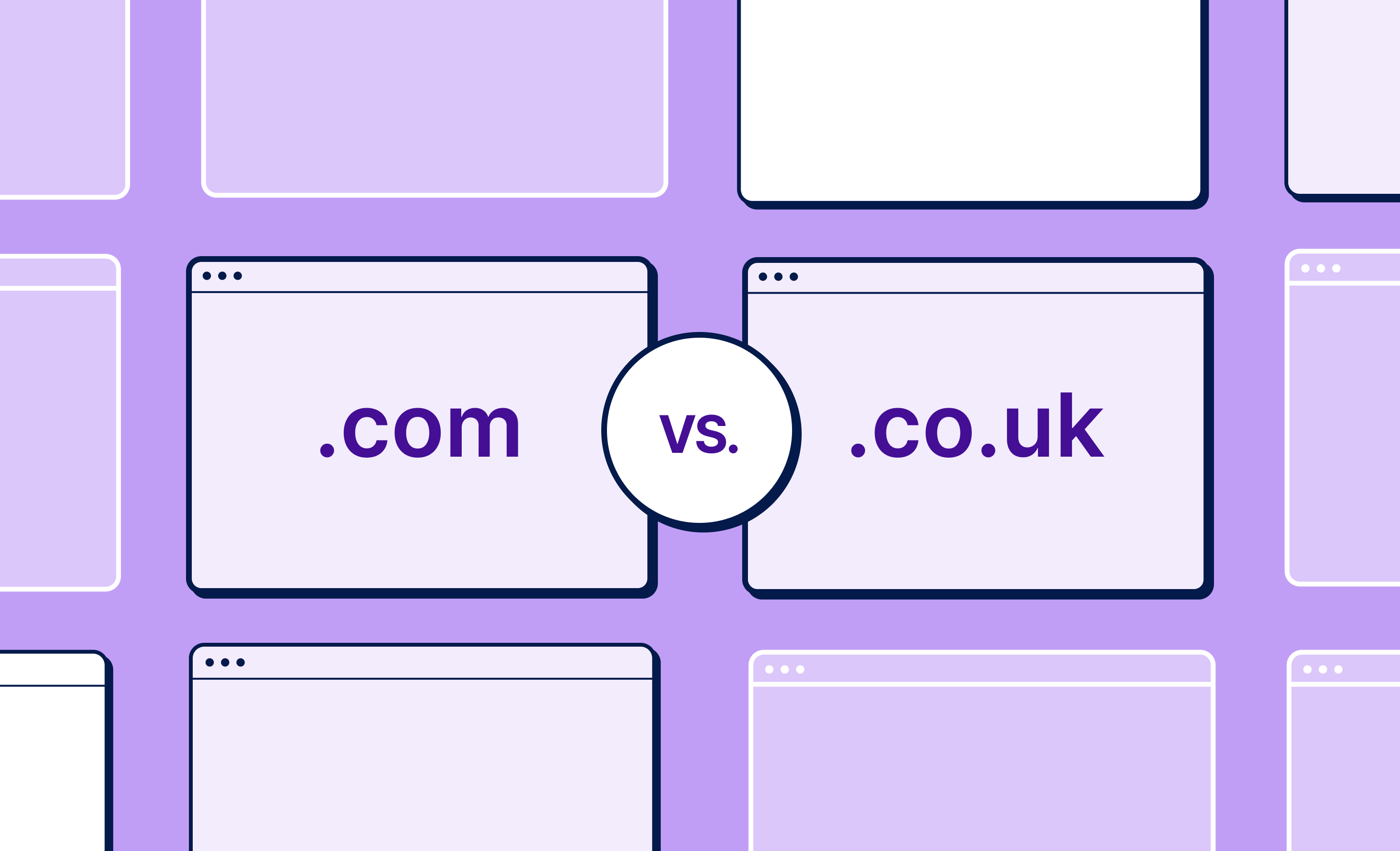
Choosing between a .com and .co.uk domain can affect how your business is perceived, where customers expect you to operate and how flexible your website is as your business grows.
A .co.uk domain is strongly associated with the UK, making it a natural choice for businesses that primarily serve British customers. A .com domain has a more international feel and is recognised globally, making it a popular option for businesses targeting customers in multiple countries.
Neither extension is automatically better – instead, the right choice for you depends on your audience, location, brand and future plans. So, if you’re deciding between a .com vs. .co.uk domain, here’s what you need to know before you register.
.com vs. .co.uk: What’s the difference?
The main difference between these two domain extensions or top-level domains (TLDs) is geographical association. A .co.uk domain is a country code TLD (ccTLD) within the .uk namespace. It has a clear connection with the United Kingdom and is widely used by UK businesses, organisations and individuals.
A .com domain is a generic top-level domain (gTLD). It isn’t tied to a particular country, so it can be used by organisations and individuals anywhere in the world.
The choice between the two therefore comes down to what you want your domain to communicate.
Feature
.com
.co.uk
Geographic association
International
United Kingdom
Best suited to
International or global audiences
UK-focused audiences
Recognition
Widely recognised worldwide
Strong recognition in the UK
Country-specific signal
No
Yes
Suitable for UK businesses
Yes
Yes
Suitable for international businesses
Yes
Possible, but more UK-specific
What is a .co.uk domain?
A .co.uk domain is a domain name with the .co.uk extension – for example, yourbusiness.co.uk. It sits within the .uk namespace, which is managed by Nominet.
The .co.uk extension has been used by UK businesses and organisations for decades and is familiar to British internet users. So, if your customers are mainly in the UK, a .co.uk domain can immediately communicate where your business operates. This can be particularly useful for local services, tradespeople, professional services, retailers and other businesses whose customers are primarily based in Britain.
However, it’s important to remember that a .co.uk domain doesn’t prevent you from serving customers internationally – it simply gives your website a stronger UK association.
A .com domain uses the .com generic top-level domain (gTLD). For example: yourbusiness.com.
Unlike .co.uk, .com isn’t associated with a specific country. This can make it a natural choice for businesses that operate internationally or want a domain that doesn’t suggest a particular geographical market. Plus, if your long-term plans include expanding outside the UK, a .com domain extension can give you this same flexibility.
.com is also one of the most familiar and trusted domain extensions worldwide. Many businesses choose it because customers already recognise it as a standard website address, and will often type it in the search bar by default when searching for a website.
Is .co.uk better for a UK business?
A .co.uk domain can be an excellent choice for a business whose main customers are in the UK. For example, a local electrician, UK-based accountant or British ecommerce business might choose a .co.uk domain because it immediately signals that the business operates in the UK, building trust, familiarity and relevance with UK audiences. If someone sees a domain ending in .co.uk, there’s little ambiguity about its geographical association.
However, that doesn’t mean every UK business should choose .co.uk. For example, a UK software company or online retailer planning to expand internationally may prefer .com because it provides a more global identity.
Therefore, the important question isn’t just “Is my business in the UK?”, but “Where do I want my business to operate and how do I want my domain to be perceived?”.
Is .com better for an international business?
A .com domain is generally the more natural choice if you want to build an international brand. Because .com isn’t associated with one country, it can work equally well for a business serving customers in the UK, Europe, North America, Asia or other markets.
For example, a business that starts in the UK but plans to expand into mainland Europe and the US may prefer ‘yourbusiness.com’ over ‘yourbusiness.co.uk’, as the .com domain doesn’t tell customers that the business belongs to a particular country.
This doesn’t mean a .co.uk domain can’t be used internationally – it can. However, the .co.uk extension continues to communicate a UK connection, which may or may not be what you want.
Does a .co.uk domain improve SEO in the UK?
A .co.uk domain can provide a geographical signal that helps search engines understand that a website is associated with the UK. Country code TLDs such as .co.uk are associated with their respective countries, which can be useful when your target audience is concentrated in one location.
However, choosing .co.uk doesn’t guarantee higher rankings in Google, and choosing .com doesn’t prevent you from ranking well in the UK. Instead, search visibility depends on many factors, including the relevance and quality of your content, technical SEO (search engine optimisation), backlinks, website performance and how well your site meets the searcher’s intent.
If your business is specifically targeting UK customers, a .co.uk domain can therefore make sense as part of your wider SEO and localisation strategy, but it shouldn’t be treated as an SEO shortcut.
ⓘ
Tip: If you want to learn more about how your domain name can impact SEO, check out our article on how to choose an SEO-friendly domain name – or discover our beginner’s guide to SEO for a crash course on all things SEO.
Does .com rank better than .co.uk?
No – a .com domain doesn’t automatically rank better than a .co.uk domain. The domain extension itself isn’t a general SEO ranking factor, so there’s no inherent ranking advantage to choosing .com over .co.uk.
However, ccTLDs such as .co.uk provide a geographical signal that can help Google understand which country a website is primarily targeting. This can be useful for websites focused on a specific country, but it doesn’t guarantee higher rankings for users in that country.
Ultimately, both .com and .co.uk domains can perform well in search results. The more important consideration is whether the domain extension matches your target audience and business strategy. For a UK-focused website, a .co.uk domain can reinforce the site’s UK focus. For an international website, .com may be a better fit.
Which domain is cheaper: .com or .co.uk?
There isn’t a universal price difference between .com and .co.uk domains, as the cost depends on the provider, introductory offers, renewal prices and any additional features bundled with the domain by your chosen domain provider. However, on average, you’ll find that .com domains tend to be slightly more expensive due to their global demand.
For example, at Fasthosts, current introductory pricing starts at £1 excluding VAT for both .com and .co.uk domains, but current standard renewal pricing is £16.92 per year for .com and £12.83 per year for .co.uk (excluding VAT). Many providers offer first-year introductory prices followed by higher renewal costs, so if you plan to keep the domain for several years, remember that the renewal price will have a much bigger impact on your total expenses.
If both versions of your preferred domain are available and the name is important to your business, registering both can be a sensible option. This will protect your brand by reducing the risk of another organisation registering and using the alternative extension, and will give you flexibility if your target market changes in the future.
This doesn’t mean you need to run two separate websites. For example, you could use ‘yourbusiness.co.uk’ as your main website and redirect ‘yourbusiness.com’ to it, or vice versa.
However, you don’t need to buy every possible domain extension. Focus on the versions that are genuinely relevant to your business and customers.
Can a .co.uk domain be used outside the UK?
Yes. There’s no requirement for your website to only serve UK customers because it uses a .co.uk domain. Therefore, a business can use a .co.uk domain while selling products or services internationally.
The consideration here is perception. A customer in another country may see .co.uk and reasonably assume that the business has a UK connection, which can actually be an advantage if being UK-based is part of your brand proposition. For example, a UK manufacturer, British retailer or specialist consultancy may want international customers to know that the business is based in Britain. However, if you want a more international appeal, .com may be a better choice.
Can I change from .co.uk to .com later?
Yes, but changing your primary domain involves more than simply buying a different domain name. If your website currently uses ‘yourbusiness.co.uk’ and you later decide to make ‘yourbusiness.com’ the main address, you’ll need to configure redirects, update internal links and review your website, email, analytics and other services.
Search engines can generally follow properly implemented redirects, but a domain change should be planned carefully to minimise disruption. For that reason, think about your likely audience and long-term plans before choosing your primary domain. If you already know that international expansion is part of your strategy, securing the .com version early can be worthwhile if it’s available.
What should you consider when choosing between .com and .co.uk?
Ultimately, there are five main questions to ask:
1. Where are your customers?
If almost all your customers are in the UK, .co.uk is a natural option. If you serve multiple countries or expect to expand internationally, .com may be more suitable.
2. How important is your UK identity?
Some businesses benefit from clearly communicating that they’re British or UK-based. A .co.uk domain can reinforce that positioning.
Others want to present themselves as international from the outset. In that case, .com may be a better fit.
3. What is available?
Your preferred domain name may already be registered under one extension but available under another.
If your exact brand name is available as both .com and .co.uk, you have more flexibility. If only one is available, consider whether the alternative domain could cause confusion with another business before registering it.
4. What does it cost to keep?
Compare both the first-year and renewal prices. A domain that looks cheaper initially may cost more over several years.
5. What are your future plans?
Your domain should ideally continue to make sense as your business develops. If you’re building a UK-only service, .co.uk may remain appropriate for the foreseeable future, but if you’re planning international expansion, .com can provide greater geographical flexibility.
How to choose between .com and .co.uk
Choose .co.uk if:
Your main audience is in the UK
Your business is strongly associated with the UK
You want your location to be clear from your web address
You primarily sell UK-focused products or services
Choose .com if:
You serve customers internationally
You plan to expand outside the UK and build an international brand
You want a domain without a country-specific association
Consider registering both if:
Both versions of your brand name are available
You want to protect your brand
You may expand internationally in the future
You want to redirect one version to your main website
There’s no universal winner in the .com vs. .co.uk decision. The best domain is the one that fits your audience, brand and long-term plans.
Buy a .com or .co.uk domain with Fasthosts
Fasthosts provides domain registration and management services for both .com and .co.uk domains, with both domain extensions starting at just £1 for the first year. Both options can be easily managed through the Fasthosts Control Panel (alongside other packages like our Email or Web Hosting), with extra features such as unlimited email forwarding, complete DNS control and free web forwarding included.
Ready to secure your domain?Search for your domain name today and check whether your preferred .com or .co.uk address is available.
Frequently asked questions
Is .com or .co.uk better?
Neither is universally better. A .co.uk domain is usually a strong choice for a UK-focused business, whereas .com is often better suited to businesses serving international audiences or planning to expand globally.
Is a .co.uk domain good for a UK business?
Yes – a .co.uk domain clearly communicates a UK connection and is a familiar choice for UK businesses, organisations, individuals and services. It can be particularly suitable when most of your customers are based in the UK.
Is .com better for SEO?
No, a .com domain doesn’t automatically rank better than a .co.uk domain. SEO performance depends on many factors, including content, relevance, technical SEO, links and user experience. Choose the domain extension that best matches your target audience and business plans.
Does a .co.uk domain help you rank in the UK?
A .co.uk domain provides a country-specific signal associated with the UK, which can be useful for a website targeting UK users. However, the domain extension alone doesn’t guarantee higher search rankings.
Can I use a .com domain for a UK business?
Absolutely. UK businesses can use .com domains, and this can be a good choice if you want to appeal to international customers or plan to expand outside the UK.
Can I use a .co.uk domain internationally?
Yes – a .co.uk website can serve customers anywhere in the world. However, the extension signals a UK association, so consider whether that matches how you want your business to be perceived internationally.
Is .com more expensive than .co.uk?
Not necessarily. Prices vary between providers and promotional offers, but .com domains tend to be slightly more expensive due to global demand. At Fasthosts, current introductory pricing starts from £1 excluding VAT for both .com and .co.uk, while current renewal pricing is £16.92 per year for .com and £12.83 per year for .co.uk.
Should I buy both .com and .co.uk?
If both domain names are available and important to your brand, registering both can be useful. You can use one as your main website address and redirect the other to it.
Can I redirect my .co.uk domain to my .com?
Yes, you can redirect one domain to another so visitors who enter your .co.uk address are sent to your .com website. This means you don’t need to operate two separate websites.
Can I change from a .co.uk domain to a .com domain?
Yes, but changing your primary domain requires careful planning. You’ll need to consider redirects, internal links, email, analytics and other website settings. A properly managed domain migration is vital to help minimise disruption.
Does buying a .com or .co.uk domain include hosting?
No. Registering a .com or .co.uk domain and hosting a website are separate services. You can buy the domain first and add web hosting, hosting for WordPress or a website builder when you’re ready to create your site.
Alternatively, some web hosting providers offer free domains with their hosting services. For example, at Fasthosts, new web hosting customers can get at least one domain completely free of charge. This is a great option if you want to secure your domain and start hosting and building your website straight away.