
Updated on 29 Oct 2025
Many businesses are now turning to distributed cloud architecture to meet their needs. Distributed clouds use multiple locations to improve performance and meet regulatory or compliance requirements.
What is a distributed cloud?
A distributed cloud is a public cloud computing service. It allows public clouds to be managed in more than one location, all from a single control panel. These locations include:
- The public cloud provider’s infrastructure
- Third-party data centres
- Other cloud providers’ data centres
- End customer premises
The great thing about having your cloud services distributed in different locations is that optimising performance is a lot easier, especially compared to the likes of multi-clouds and hybrid clouds. For example, running applications in various environments can help boost your performance requirements. This is because you can spread out your services across multiple locations to make the most out of each. Moving cloud services closer to a user, application or data through a distributed cloud can reduce latency, lower network congestion, and offer a better quality of service.
In addition to improving performance, distributed cloud computing helps businesses comply with ever-changing data regulations. For example, legislation such as GDPR can stipulate that data is stored in specific jurisdictions, which means that distributed cloud infrastructure may be necessary to keep data in the right places.
Distributed clouds are also perfect for edge computing, and this is because their applications run closer to the original data point. But we’ll touch on this later.
How does a distributed cloud work?
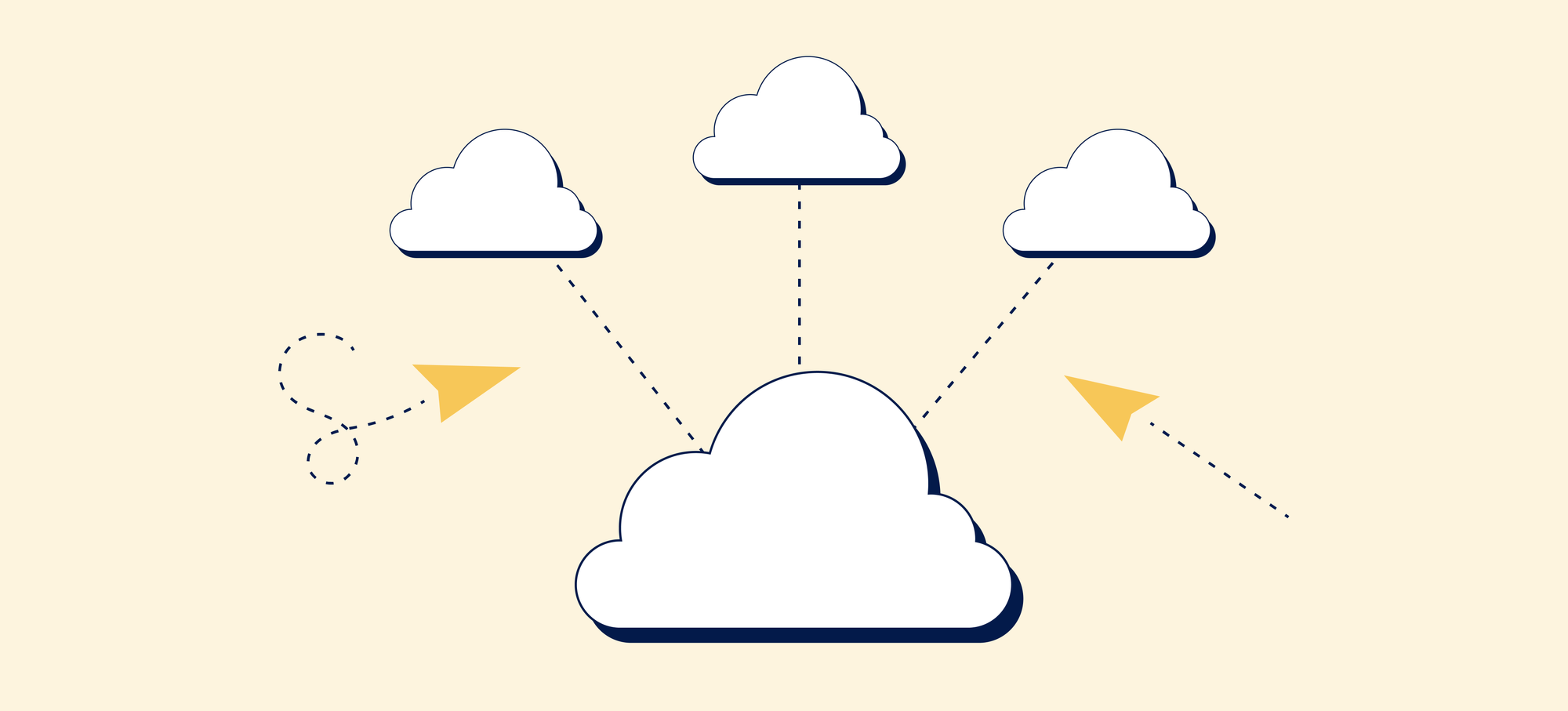
Each component of a distributed cloud is spread across various locations through micro-cloud satellites. To communicate with one another, a distributed cloud uses both messaging and APIs. An application programming interface (API) is a type of software that allows public clouds to communicate with each other within a distributed cloud. This maximises performance and efficiency. The distributed cloud provider will still have control over all of the infrastructure, security, and other features, allowing you to access every part as a single cloud.
Distributed cloud and edge computing
Edge computing and distributed clouds are often used together. Edge computing is the practice of running your applications as close to the point of data creation as possible. This type of computing has become essential for catering to large volumes of data, processing these at increasingly high speeds to ensure low latency. Edge computing can operate separately from a distributed cloud, but in combination, they make a strong match.
Distributed cloud architecture
Distributed cloud computing architecture has three core layers:
- Control plane: This centralises management, policy, and security across all distributed locations.
- Data plane: This executes workloads locally, ensuring data is processed in the right place for speed and compliance.
- Networking: Distributed cloud networking links everything together, maintaining reliability and resilience across sites.
By combining these elements, distributed cloud architecture gives organisations the ability to manage global services with local precision.
What are the benefits of a distributed cloud?
Perfect for a wide range of services, distributed clouds have a number of great benefits:
1. Improve multi-cloud and hybrid cloud management
To boost control over hybrid and multi-cloud structures, a distributed cloud can be implemented. This helps to control everything from one localised panel. Therefore, you can benefit from the reduced latency and superior performance of distributed clouds whilst also benefiting from centralised management, which simplifies the management process and smooths out inconsistencies across the cloud environment.
2. Cost-effective and scalable
If you’re wanting to cut data-led costs, a distributed cloud may be the next best thing. Using a distributed cloud allows users to build on their existing infrastructure and deploy to other locations without paying for a costly physical structure.
3. Speedy content delivery
Boost your content delivery network with a distributed cloud. By storing content closer to your users, a distributed cloud boosts content performance and reduces latency. This helps you deliver a more consistent quality of service.
4. Improved compliance
Distributed cloud computing helps businesses comply with data regulations by allowing them to store data in approved locations. Thanks to distributed clouds, data can be both accessible and protected.
5. Superior processing and performance
By using multiple systems for each task, distributed cloud computing can greatly increase processing speeds and deliver data more quickly. This leads to improved performance compared to centralised networks and traditional cloud services.
The real value of distributed cloud
Cloud services that are offered by public cloud providers are “distributed” out to a number of specific physical locations. If operations are physically closer to those who require them, the capabilities enable low-latency computing and also ensure that there is a consistent control plane. This will administer the cloud infrastructure from public to private cloud, and work consistently across both. When working together, this can result in major improvements to performance as latency issues are all but eliminated, along with the risk of network-related outages across the world and control plane inefficiencies.
This brings additional benefits of distributed cloud to the table, including:
- Resilience and uptime: If one location experiences problems, workloads can shift to another site to reduce downtime.
- Support for edge services: Distributed cloud is designed to work well with edge computing, enabling new applications such as smart cities, IoT, and autonomous transport.
- Governance: With distributed cloud compliance, organisations can keep sensitive workloads within borders, crucial for sectors like healthcare and finance.
The challenges of distributed cloud
Managing a multisite cloud deployment is not without its challenges. There are a few hurdles to overcome before distributed cloud can be widely adopted:
- Bandwidth issues – A multicloud environment across different locations may feature different connectivity models. Moving more computing over to the edge can put stress on existing broadband connections, and can often need investment to upgrade or adapt to meet these additional demands.
- Security – For both providers and customers, the challenge of keeping the cloud secure is a prominent one. The resources used can sometimes be dotted around the world and collocated with other storage resources and enterprise servers.
- Data protection – Business continuity and cloud backup plans are important for a business of any size. Those that have dispersed data resources may need a redesign of the strategies in place to ensure the right data stays where it needs to.
The widespread adoption of distributed cloud also raises some questions:
- How many public cloud capabilities will be accessible and available on distributed cloud? Although this isn’t essential, the answer does dictate the type of distributed cloud required – fully or partially distributed.
- Will certain custom scenarios emerge for distributed cloud substations?
- Will it require a constant connection, or is variable connectivity possible?
Distributed cloud uses
Now let’s take a look at how distributed cloud can be utilised:
1. Intelligent caching
Video streaming services can make use of distributed cloud to act as a centralised system whereby videos are encoded and converted for playback on different devices across multiple networks. These multiple caches will exist for all content, and if – for example – a large amount of traffic is expected for an upcoming episode, a cache can be stored near to the actual viewer. If you think this sounds like a lot of work, you’d be right. Larger storage at servers close to residential areas or 5G stations in heavily populated urban areas are two ways to ensure seamless playback.
2. Intelligent transport
Trucks run up and down our roads day and night, and they are essential for keeping things running. Distributed cloud can be used within logistics if trucks that are travelling autonomously are able to send traffic and engine data back to the cloud server. But those systems can also use local interpreted data from onboard the vehicle and use road sensors to maintain a safe and consistent speed and distance from other vehicles.
A truck’s progress towards its final destination will be tracked by a fleet application within the regional cloud, which utilises all the information it collects from multiple vehicles to decide on the most efficient route and pinpoint the locations of vehicles needing repairs.
3. Improved visibility and manageability
If an organisation has a hybrid multi-cloud infrastructure, then distributed cloud can help provide more visibility and management from a single console, with one set of tools. This makes the management process much quicker and easier, and since visibility is improved, developing problems can be spotted and dealt with before they escalate.
4. It’s efficient, scalable and agile
Expanding a dedicated data centre, or building a new one in a different location, is time-consuming and expensive. By using distributed cloud, a business or organisation can expand existing infrastructure or edge locations without needing that physical buildout. The cloud can be developed and deployed anywhere at speed.
5. Data privacy
Many industries – such as healthcare and telecommunications – have regulations regarding the protection of customer data. Some regulations may state that a user’s personal information cannot leave the user’s country. A distributed cloud infrastructure makes it much easier for that information to be processed and kept in each user’s country of residence.
6. Internet of Things (IoT)
So much of the technology around us nowadays relies on real-time data analysis, including self-driving cars, healthcare applications, smart devices and buildings, and video surveillance. In instances like these, the “real-time” becomes less so when the data has to travel to a central cloud data centre and back again. Distributed cloud can help to deliver the low latency that these uses require to work properly.
Emerging uses of distributed clouds
In addition to current applications in content delivery, logistics, and IoT, distributed cloud is starting to shape new opportunities across different industries. A few of the most promising areas include:
AI and machine learning
Artificial intelligence models are often trained on large, centralised platforms, but the real value comes when they are deployed closer to where decisions need to be made. Distributed cloud allows machine learning models to run on local nodes, providing faster insights without sending all the data back to a central hub. This approach is increasingly important in areas like fraud detection, predictive maintenance, and personalised healthcare.
Retail
Retail environments benefit from keeping essential systems local, while still linked to wider cloud platforms. With distributed cloud, payment processing, stock control, and customer data can be handled in-store, ensuring speed and reliability even if wider connectivity is interrupted. At the same time, these local systems remain part of a central cloud strategy, giving retailers a full view across branches and regions.
Manufacturing
Factories generate huge volumes of sensor and machine data every second. Traditionally, sending all this information to a central cloud could create delays. By processing data through distributed cloud nodes located near the production line, manufacturers can respond in real time. This reduces downtime, improves quality control, and helps businesses adapt quickly to changes on the shop floor.
Distributed cloud vs traditional cloud
What’s the difference between a distributed cloud vs traditional cloud? Traditional cloud refers to the delivery of IT resources and services on demand, which includes – but isn’t limited to – storage, servers and databases. Services such as these will normally be provided over a private network connection or the public internet from one of the many cloud providers out there.
The term ‘cloud services’ can refer to public cloud, private cloud, hybrid cloud, and multi-cloud. Within these four main cloud structures, there are also three main types of cloud computing models, including Infrastructure-as-a-Service (IaaS), Platforms-as-a-Service (PaaS), and Software-as-a-Service (SaaS). These services provide essential IT infrastructure, help businesses develop and deploy cloud-based applications, and allow users to access pay-as-you-go software via the internet.
On the other hand, distributed cloud computing does away with the boxes of public, private, hybrid and multi. Instead, it presents as a single cloud platform. But distributed cloud is made up of multiple components that include all of the above elements. Regardless of where they come from, these varied elements are managed as one.
Distributed cloud vs hybrid cloud
Hybrid cloud and distributed cloud are sometimes confused, but they serve different purposes.
- Hybrid cloud combines public and private environments, allowing workloads to shift between them.
- Distributed cloud spreads public cloud services across different physical sites, from providers to customer premises, while still managed centrally.
Some organisations use both approaches – hybrid cloud for flexibility and distributed cloud for compliance and performance.
Does your business require distributed cloud architecture? Chat to our sales team, they'll be able to guide you towards the products and solutions that are right for you.