Welcome to the beginning of your brand new WordPress website! How are you feeling? Nervous about exceeding the quality of your competitor’s site? Or not too precious about the end product, but just keen to create an online home for your brand?
Or maybe you're somewhere in the middle? You’re probably creating a website because you’ve got something great to sell, provide, or tell. So don’t overthink it beyond the key objective – guiding your audience to the product or service.
Your key focus should be on clear navigation, accessibility and making the customer journey simple. Focus on that and the rest will fall into place.
In this blog, we'll go over some of the essentials when creating your WordPress site, as well as why it's important not to overlook these things.
The importance of a good website
Before converting, most consumers will interact with your brand a number of times. This might start through word-of-mouth, social media or something else. But the first touchpoint they’ll go to is your website. The power of this first interaction is crucial and has to be a positive one if they’re going to keep coming back. Ultimately, it all comes down to the user experience (UX).
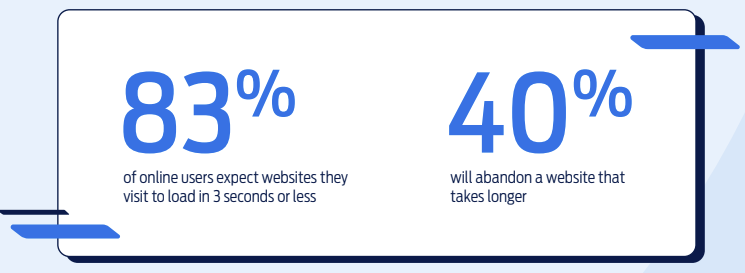
So yes, page speed really does matter, and slow loading times could derail the customer journey before it’s even begun.
First impressions go far in all walks of life, so when a user does get access to your site, the first thing they’ll notice is your website design. This will determine how consumers perceive your brand going forward.
Next stop – navigation. Website users spend an average of 6.44 seconds focused on the main navigation menu. That’s how long you have to create a positive user experience. If it’s clear and easily accessible, then that’s all the time they should need.
Now that you're getting a feel for the customer journey, it's clear to see just how important these first fundamentals are. Consumers, especially online, are inherently impatient and will waste no time heading to a different store if the UX is poor.
4 key things to consider
The good news about impatient consumers is that they can be won over just as easily as they're put off. So, following on from the previous section, we suggest you make the following 4 considerations before building your WordPress website.
- Customer needs
According to Deloitte research, customer-centric companies are 60% more profitable than product-centric ones. The latter often still care about their customers, but they just haven't drilled down into their primary needs and behaviours at the first touchpoint stage.
We've said it before and we'll say it again – user experience is key. Your problem solving product and competitive pricing won't mean a thing if they don't stick around long enough to find out.
- Website speed
Also known as page speed, this is the time it takes for the content of a page on your website to fully load. And as we've already established, slow loading has an adverse impact on whether someone will stick around or bounce.
But when you consider that the average page load speed of sites ranking on page one of Google is 1.65 seconds, your SEO comes under fire too. Choosing the right host can help with this – but more on that later.
- Navigation and accessibility
The overall efficiency of your website will be directly impacted by how easily it can be navigated. From the homepage, your audience shouldn't have to think twice about accessing the menu, finding the page or action they want and clicking through to it.
But to make sure everyone has a seamless experience on your site, you should also consider the accessibility – ensuring your website is usable regardless of a disability or impairment. Navigation plays a big part here, as does readability and minimising excess function.
- Design
Just like page speed, the design of your website can attract or repel visitors, as well as impacting SEO. So, when choosing and adapting the aesthetics, you've got two audiences to bear in minds – your consumers and Google.
Poor website design featuring clunky, slow-loading elements that aren't optimised for mobile will stunt your SERP (search engine results page) ranking on Google. That's because Google recognises you're delivering a poor user experience.
Knowing your audience is key – what will they consider to be unappealing or outdated? What will they warm to? A positive experience can also give a positive impression about the kind of business you are when it comes to customer service, building trust right off the bat.
Your WordPress site in 6 steps
Now that you have a good idea of consumers' needs and the fundamental factors that keep them moving towards a conversion, it's about time we covered some essentials for when you press on with your website.
- Host with the most
The best websites are built on the strongest foundations. A hosting platform can give you that, from page speed and security, to uptime and availability. This is an essential step before what comes next, because without a host your website can't get online.
If growth is in your sights, make sure your solution is scalable. If you're expecting peaks of traffic, make sure it can perform under pressure. Remember, it pays to invest in your hosting provider.
- Domain decisions
Your domain name is the first point of reference for many customers. Make it simple, make it memorable, and make it stand out from the crowd.
Try not to stray too far away from your business name to keep that brand association strong to boost visibility through SEO.
- A site of your own design
Are you expecting visitors with a bit of flavour and flamboyance? Go dynamic. Think your audience will prefer slick and to the point? Go simple. But whatever you do, just make sure your design reflects your brand, and your target audience.
It’s important to strike the balance between standing out in your industry and making sure key info and products are easy to find. And don’t forget about SEO – never underestimate the power of good site design.
- Plug in your plugins
There's tons of reasons why WordPress is a good choice for your website, but plugins are up there with some of the most important. There are over 60,000 free plugins out there, with tens of thousands more paid ones, all there to help give your site a boost.
Some are industry specific, some help build your site, while others are designed entirely to solve specific problems. Whether you're a beginner or website building pro, we recommend these top plugins for a fully functioning website.
- Landing pages
A copywriter's dream and business owner's secret weapon for conversions, landing pages are the final destination you'll want to drive consumers to during a campaign. Think product and service launches, competitions, sales, events, etc...
Get inside the minds of your customers and think about what they'd want to see – testimonials, galleries, forms, carousels, and more.
- Make it mobile
Over 60% of website traffic comes from mobile devices. So last but definitely not least, you need to make sure your website prioritises or responds well to mobile browsing.
Forgetting this can lead to slow page speed, clunky navigation, and warped content – all of which, as you can imagine, are major consumer turn offs. Site already live? Check it on your phone ASAP to make sure the aesthetics and functionality perform as they should.
Get online today
From picking the right theme to getting ahead of the curve, your WordPress journey can be boundless if you start with the right foundations and essential considerations.
We know there’s a lot to take on board and get started with. Our advice? Keep it simple, don’t panic and give us a shout. We specialise in all things websites and WordPress, which is why we’re the go-to partner for all kinds of businesses who need a lift with their online ventures.
If it’s Hosting for WordPress you’re looking for, we’re here to help – whether you’re a beginner or a WordPress pro, we’ve got all the features and support to get you started.
Plus, we provide built-in security to keep your site safe, with scalable performance and exceptional uptime to meet consumer demands.
And our team are around 24/7 to answer any questions you might have. Just give us a call on 0333 0142 700 or message us via live chat.