
Updated on 11 Feb 2026
If you’re starting out with coding, you’ll come across lots of different programming languages and advice on which one to learn first. Two of the most common are PHP and JavaScript, especially if you’re planning to host a website or set up a .dev domain. Both play big roles in how websites work, but they’re used in different ways. JavaScript handles the interactive parts you see in the browser, while PHP works behind the scenes to manage data, logins, and server tasks.
In this article, we’ll look at PHP vs JavaScript, how each language is used in web development, where they differ, and the types of projects they suit best. By the end, you’ll have a clearer idea of which one fits your goals – or whether learning both makes the most sense.
What is PHP?
PHP, developed by Rasmus Lersdorf in 1995, is a server-side programming language used in backend web development. Unlike client-side languages that run in your browser, PHP runs on the web server and processes code before the page is sent to the user. This makes it ideal for building features that rely on storing, retrieving, or updating data behind the scenes.
PHP powers a wide range of real-world tasks, including:
- Building dynamic, database-driven websites
- Handling forms and processing user input
- Generating server-rendered pages
- Managing logins, sessions, and user accounts
- Running popular CMS platforms like WordPress, Joomla, and Drupal
- Working with MySQL or MariaDB databases as part of the classic “LAMP” stack
Because so many content management systems use PHP, it’s widely supported across most web hosting plans, including managed hosting for WordPress. This is why many people choose PHP for web development when building content-heavy or database-driven sites.
PHP remains popular thanks to its huge community, open-source ecosystem, and regular updates. The most recent version, PHP 8.5, was released on 20th November 2025 and continues to improve performance and developer experience.
You’ll see PHP used in plenty of everyday places – things like booking systems, contact forms, checkout pages, dashboards, and any site that needs to pull information from a database. WordPress sites also rely on PHP for almost everything behind the scenes.
What is JavaScript?
Created by Brendan Eich in the mid 90s, JavaScript, or “JS”, is a programming language that’s used on both the backend and frontend. When paired with HTML and CSS, it provides web pages with dynamism and interactivity – such as pop-ups, animations and more. Even something as simple as an age verification for entering a website is coded in JavaScript.
While JavaScript started as a browser language, it has grown far beyond that. Today, tools like Node.js let developers use JavaScript on the server as well, so the same language can be used for both the front and back end of a website.
Modern JavaScript also follows a set of rules called ECMAScript (often shortened to “ES”). These updates keep the language fresh and introduce new features every year, which is why so many developers enjoy working with it.
There’s also a huge ecosystem of frameworks that help you build things faster. React is a popular choice for the front end, but developers also use frameworks like Next.js, Vue, and Svelte to build smooth, fast interfaces. On the server side, many use Express.js with Node.js for handling routes, APIs, and other backend tasks.
Because JavaScript is everywhere, it’s one of the most common skills in web development jobs. Many people start their careers by learning JavaScript first, as it’s used in so many different places.
JavaScript shows up in lots of day-to-day features, like drop-down menus, pop-ups, instant search boxes, live chats, small animations, and other parts of a page that react as soon as someone interacts with them. Developers also use it to build full interfaces and web apps with tools like React, Vue, and similar frameworks.
Client-side vs server-side scripting
It helps to understand the difference between client-side and server-side scripting, because this explains what JavaScript and PHP actually do on a website.
Client-side scripting is everything that runs in your browser. When you click a button, see an animation, or get a quick message without the page reloading, that’s the browser doing the work. This is where JavaScript began, and it’s still the main language used for these kinds of features. Because the code runs on your device, the page can react fast without waiting for the server.
JavaScript is still the go-to for client-side work, but with tools like Node.js, it can now run on the server too.
Server-side scripting, on the other hand, happens on the web server before anything reaches your screen. The server receives your request, runs the code, fetches information from a database if needed, and then sends back the final page or result.
PHP is a server-side language. It doesn’t run in the browser at all. The server handles everything and sends the finished output to you. If you’re planning to create an e-commerce website, the server-side work becomes especially important because the site needs to handle things like logins, baskets, payments, and order details securely.
A simple way to picture it:
- Client-side: what you see and interact with
- Server-side: what builds the page and handles data behind the scenes
For example, when you type your password into a login form, the little “This field can’t be empty” message comes from the client side (usually JavaScript). But checking whether your password is correct happens on the server side (often PHP).
PHP vs JavaScript in a nutshell
Here’s how the two languages compare at a glance.
PHP vs JavaScript jobs over time
We looked at Google Trends data to see how interest in PHP vs JavaScript jobs has changed. The graph shows that both languages move up and down a lot, often at the same time. Neither one stays consistently higher, and there isn’t a strong long-term rise or fall for either language.
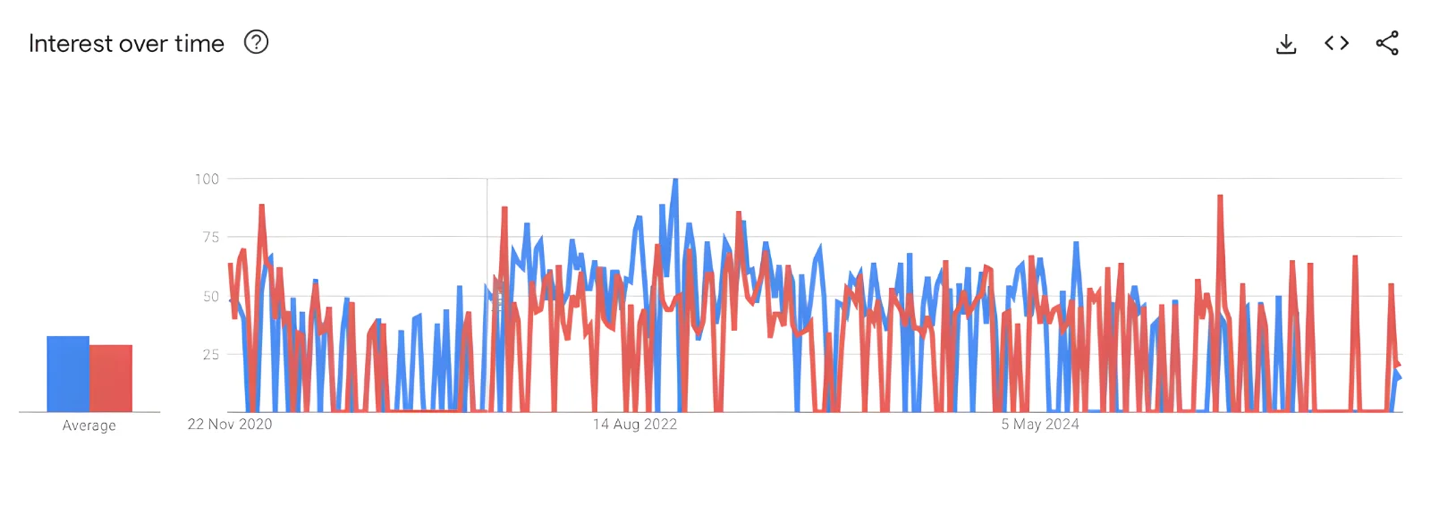
What it does show is that interest in both skills is steady. When searches drop for one, the other usually dips too, which suggests that demand for PHP and JavaScript tends to follow the same overall pattern. This makes sense, as both languages are used widely across the web and remain important in everyday web development work.
PHP and JavaScript career paths
Both PHP and JavaScript open the door to different types of web development jobs, and it’s common for developers to learn one first and pick up the other later.
PHP roles
A lot of PHP jobs are tied to building and maintaining content-heavy sites. Many businesses, agencies, and e-commerce teams use WordPress, Magento, Drupal, or custom PHP systems every day, so there’s steady demand for developers who can work with these platforms. Typical PHP roles involve managing databases, building secure login systems, creating dashboards or internal tools, and keeping large websites running smoothly.
JavaScript roles
JavaScript jobs range from simple front-end work to full app development. On the front end, developers build menus, animations, and interactive features using frameworks like React, Vue, or Svelte. On the back end, Node.js creates roles focused on APIs, chat features, real-time updates, and services that need quick responses. Many JavaScript jobs also involve working closely with designers or product teams to build smooth interfaces.
Full-stack paths
Because JavaScript can run in the browser and on the server, many developers move into full-stack roles using Node.js and a front-end framework. PHP developers can also become full-stack by learning JavaScript for the front end and using PHP on the back end, which is common in WordPress and Laravel work.
Hiring in different regions
Job demand can vary depending on where you live. In the UK and Europe, PHP roles are often found in agencies, hosting companies, charities, and e-commerce teams. JavaScript roles tend to be more common in tech startups, SaaS companies, and businesses that build their own in-house tools. Both languages have strong communities and plenty of ongoing work, but the job style and project types can look different.
PHP and JavaScript compared
Performance and speed
Because PHP runs on the server, its speed depends a lot on how strong the server is. Each time someone visits your site, the server reads the PHP code, talks to the database if needed, and sends back the finished page. With PHP 8 and later versions, this process has become much quicker thanks to features like the JIT (Just-In-Time) compiler, which helps PHP handle certain tasks faster than before.
JavaScript works a bit differently. In the browser, JavaScript runs through the V8 engine (the same one used in Chrome), which is designed to execute code very quickly. When JavaScript is used on the server through Node.js, it still benefits from this engine, which is one reason many developers like using it for apps that need fast responses.
One big difference between PHP and JavaScript is how they handle tasks:
- PHP is mostly synchronous, which means it usually works through one task at a time.
- JavaScript can run tasks asynchronously, which allows it to keep going while waiting for something else to finish – for example, a database call or an API request.
In simple terms, JavaScript doesn’t have to “wait in line” as often, which can make it a good fit for things that need constant updates, like live chats or streaming features. PHP can still be fast, but it handles tasks in a more step-by-step way.
Both languages can perform well when used in the right place. The speed you see often depends on how the website or app is built, and the quality of the server it’s running on.
Learning difficulty
PHP coding is often easier for beginners because the logic is straightforward. JavaScript, on the other hand, is known to have a steeper learning curve, particularly as it can be used for frontend and backend scripts. Despite how daunting it may seem, it’s vital to learn if you do go down the frontend route in particular.
Community support
PHP and JavaScript are incredibly popular languages in the web development space. Sites like Stackshare.io, which has a large JavaScript community, prefer it due to its use on frontend and backend, as well as the huge library of open-source frameworks developers can access. It’s so popular that sites such as Netflix, Meta and even NASA use JavaScript.
To contrast this, PHP is loved by the community due to being open source and is used by popular sites like Slack, Facebook and much more. While not as popular as JavaScript, PHP is fully open source, whereas JavaScript itself is not.
From an employability standpoint, learning both languages will land you some serious gigs, and may even help you integrate with communities on GitHub.
Syntax and logic
Whether you decide to learn JavaScript or PHP is down to personal preference. Typically, characteristics of a programming language are reasons why developers may prefer certain ones. Here are some things to look out for when trying to spot JavaScript and PHP, as well as general rules to know about both:
JavaScript
Below is a typical example of how a script may be written using JavaScript – <script> is the biggest giveaway here:
<script>
document.write("This is how you structure JavaScript");
</script>
PHP
PHP can be placed anywhere in a script and starts <?php. Below, we have an example of a simple PHP file, with a PHP script that uses a built-in PHP function "echo" to output the text "This is what PHP looks like" on a web page:
<?php
echo "This is what PHP looks like";
?>
Backend dev
JavaScript is a popular choice for backend work when you need a steady, ongoing connection between users and the server. With Node.js, JavaScript can handle lots of tasks at the same time without slowing down. This makes it a good fit for things like chat apps, live notifications, streaming platforms, multiplayer games, or anything that updates in real time. It also works well for sites that get a lot of traffic because it can respond quickly without getting stuck waiting for one task to finish before moving to the next.
PHP is often used for websites that rely heavily on databases or have a lot of content. This includes online shops, dashboards, blogs, and membership sites. PHP for backend work is common in platforms like WordPress, Magento, and Drupal, and many businesses use it to handle logins, checkout pages, and content management. PHP works smoothly with MySQL and similar databases, which makes it a dependable option for websites that store and display large amounts of information.
Both languages are used to build APIs, with PHP common in traditional setups and JavaScript (Node.js) popular for lighter, faster endpoints.
In practice, both PHP and JavaScript are used on the backend. The right choice depends on the type of project and the kind of work your website or app needs to do.
Security
Security works differently for PHP and JavaScript, mostly because of where each one runs.
PHP is generally seen as safer by default because the code stays on the server. Visitors can’t open your browser’s “View Source” and see how it works. But PHP isn’t automatically secure. How secure it is depends a lot on how the developer writes the code. Things like sanitising form input, escaping data before sending it to the database, and keeping libraries up to date all play a big part in keeping a PHP site safe. Most modern PHP frameworks, like Laravel and Symfony, help with this by including built-in tools that handle common security tasks for you.
JavaScript works differently because a lot of the code runs in the browser. This means people can see it, copy it, or try to change how it behaves. That doesn’t make JavaScript unsafe on its own, but it does mean developers need to be careful. One common risk is XSS (cross-site scripting), where attackers try to inject harmful scripts into a page. Another thing to watch out for is the number of third-party packages JavaScript projects often rely on. Outdated or untrusted packages can introduce security gaps if they’re not checked properly.
That said, JavaScript has plenty of ways to stay secure. Frameworks like React and Vue escape data automatically, which helps prevent certain attacks. Node.js also has tools that scan for risky packages and alert developers when something needs to be updated. And while SSL certificates don’t protect the code itself, they do protect the data being sent between the browser and the server, which is an important part of keeping any JavaScript-powered website safe.
Both PHP and JavaScript can be secure when used correctly. The real difference comes down to how the code is written, how well the site is maintained, and how carefully developers handle user input and third-party tools.
PHP vs JavaScript for web development
It helps to see how PHP and JavaScript compare when you’re building different parts of a website.
PHP handles a lot of the behind-the-scenes work, while JavaScript powers the parts you see and interact with. Many websites use both.
Which should you learn first?
Choosing whether to start with PHP or JavaScript depends on the type of projects you want to build.
If you’re drawn to the interactive side of websites – menus, pop-ups, animations, or anything that reacts in the browser – JavaScript is usually the easier place to begin. You can see your changes straight away, and the basics fit well with HTML and CSS, so it feels like a natural next step for most beginners.
If you’re more interested in the “behind the scenes” part of a website, PHP can be a good starting point. It’s used for things like logins, forms, dashboards, blogs, and anything that needs a database. Many beginners learn PHP through WordPress because it’s straightforward, well documented, and you can build a working site quickly.
There’s no right or wrong choice here. Most developers end up learning both over time, but your first pick should match the kind of websites or features you want to create right now.
Frequently asked questions about PHP and JavaScript
JavaScript vs PHP: Which is easier to learn?
Like learning any language (spoken or otherwise), you’ve got to have the right level of motivation and discipline. While one language may be easier to learn in theory, your motives for learning a programming language can make the process of learning it easier.
PHP is seen as “easier” due to the number of resources and documentation on the internet, plus a widespread community for when you need help with your scripts. However, JavaScript is often seen as far superior due to its interactive component building and backend frameworks like Node.js to handle specific tasks. While JavaScript does have a learning curve, there’s always something new to learn, which means more possibilities in your scripts.
Should I start with PHP or JavaScript?
Start with JavaScript if you want to work on interactive front-end features. Start with PHP if you prefer server-side work like forms, logins, and database-driven pages. Both are useful, and many developers learn them in either order depending on their projects.
Is PHP better than JavaScript?
Neither language is better than the other, because they’re used for entirely different purposes when it comes to web dev. PHP is known as a backend language almost exclusively, and can be used to generate dynamic content as well as handle data. JavaScript is used for developing interactive elements on a web interface. It’s not uncommon to find both languages used for web applications, so a full-stack approach to your webpage may be the best solution.
If a constant connection is required between the site, server and user, then JavaScript may be the optimal solution. However, if you need to work with management systems like MySQL or need something more secure where source code cannot be accessed by anyone, then PHP can be a good choice in this instance.
Want to put your PHP or JavaScript to good use with one of our Web Hosting solutions? Get in touch to see how we can help kick-start your next project or business. If you’re hosting on WordPress, be sure to check out our range of WordPress themes to get your e-commerce site up and running with a great look and feel.